
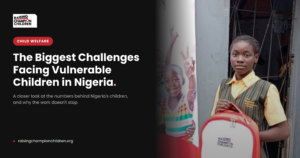
A child prepares for a new school term with rcci even as millions of Nigerian children still face baarriers to education, health and basic care.
Child Welfare in Nigeria: The Biggest Challenges Facing Vulnerable Children Today
Millions of children in Nigeria wake up every day without enough food, without a safe classroom, and without the protection every child deserves. This is what child welfare in Nigeria really looks like right now, and the numbers are hard to ignore. Behind every statistic is a real child, a real family, and a future that shouldn’t have to be this hard to reach.
At RCCI, we work with these children every day, so this isn’t just data to us, it’s the reality we see up close. Here’s a clear look at what’s actually going on, broken down into the areas that matter most.
Millions of Children Are Still Out of School
Nigeria has more out-of-school children than any other country in the world. Recent figures from UNICEF put the number at over 10 million children of primary school age alone, with some reports counting closer to 18 million once secondary school-age children are included. To put that in perspective, that’s more children missing school in Nigeria than the entire population of many countries.
The reasons aren’t simple. Poverty keeps children home because families can’t afford books, uniforms, or transport, even when the school itself is technically free. In some parts of the country, insecurity has forced schools to shut down entirely. In others, long-standing cultural norms mean girls are pulled out of class earlier than boys. Whatever the cause, the result is the same: a child without an education has a much harder road ahead, in every part of life.
Poverty Is Touching Almost Every Nigerian Child
According to UNICEF’s most recent report on Nigerian children, two out of every three children in the country are growing up in what’s called multidimensional poverty. That simply means they’re missing more than one basic thing a child needs, whether that’s healthcare, clean water, proper nutrition, or a safe place to live.
This kind of poverty doesn’t stay in one lane. A child who’s hungry struggles to concentrate in school. A child without clean water is more likely to fall sick. A child without healthcare access might not survive an illness that would be easily treated elsewhere. Poverty is often the root cause sitting underneath almost every other challenge on this list.
Malnutrition Is Affecting a Child’s Body Before They Even Get a Fair Start
Nigeria has one of the highest numbers of malnourished children in the world, second only to India globally. Close to 40% of children under five are stunted, meaning their growth, both physical and mental, has been permanently affected by not getting enough good food early in life. On top of that, a smaller but still serious number of children suffer from wasting, a more severe and immediately dangerous form of malnutrition.
Stunting isn’t something a child can simply “catch up” from later. It affects brain development, school performance, and long-term health, which is part of why proper nutrition in the first few years of a child’s life matters so much.
Child Marriage Is Still Robbing Girls of Their Childhood
Despite Nigeria’s Child Rights Act making marriage under 18 illegal, roughly two in five girls in the country are still married before they turn 18. In some northern states, that number climbs even higher, with more than six out of ten girls married as children.
Child marriage almost always means the end of a girl’s education. It also comes with serious health risks, since young girls’ bodies aren’t ready for pregnancy and childbirth. Behind this practice are usually a mix of poverty, tradition, and limited opportunities for girls to see another path for their lives.
Child Labour Is More Common Than Most People Realise
A national survey by Nigeria’s Bureau of Statistics and the International Labour Organization found that close to 4 in 10 Nigerian children between ages 5 and 17 are involved in child labour. In rural areas, that number is even higher. Many of these children work in farming or family businesses, and more than half are exposed to some kind of workplace hazard while doing it.
Child labour and school attendance rarely go together. A child spending their day working is a child who isn’t in a classroom, which quietly feeds right back into the education crisis above.
Violence Against Children Is Widespread, Even If It’s Rarely Talked About
More than half of Nigerian children experience some form of violence before they turn 18, according to UNICEF’s latest findings. This includes physical, emotional, and sexual abuse, much of it happening in places that should be safe, like homes, schools, and communities.
Part of the problem is that this kind of violence is often normalized or kept quiet, which makes it even harder to track and address. Stronger child protection systems, more awareness, and safe spaces for children to speak up all play a role in slowly changing this.
Where Real Change Actually Starts
None of these challenges exist on their own. A child dealing with poverty is more likely to face malnutrition, more likely to be pulled into child labour, more likely to be married off early, and more likely to be out of school entirely. They all feed into each other, which is exactly why fixing just one piece rarely solves the whole problem.
This is the reality organisations like RCCI work in every day, whether that’s making sure a child has a school bag to start the term, supporting a family through a health emergency, or simply giving a child access to the kind of small, steady support most children shouldn’t have to go without.
Change happens slowly, one child, one family, one community at a time. But it does happen, and every bit of support toward it counts.